
If not properly treated, atrial fibrillation gets more severe. Atrial fibrillation can lead to stroke, heart failure, and other health problems. Read about how atrial fibrillation impacts your heart and other health risks.
What Health Conditions Can Result from Atrial Fibrillation?
Atrial fibrillation is tied to a higher risk of stroke, heart failure, dementia, and other health problems.
How Can Atrial Fibrillation Lead to Stroke?
Atrial fibrillation is a significant cause of stroke.
- People with atrial fibrillation are 5 times more likely to have a stroke.1
- Data show that 15-20% of strokes are related to atrial fibrillation.2
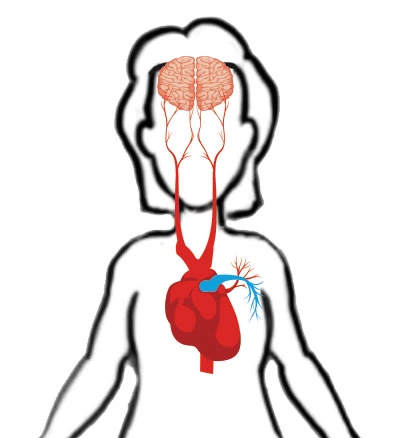
Atrial fibrillation causes the atria to beat too fast. The atria cannot contract as they should. As a result, blood pools in the atria. When blood pools, it can clot. If a blood clot travels to the brain, it can cause a stroke.
Certain people with atrial fibrillation are at particularly high risk. For example, the risk of a stroke is higher if:1
- You are a woman
- You have persistent atrial fibrillation (lasting more than one week) instead of shorter durations of atrial fibrillation, called paroxysmal
Also, people are more likely to die from strokes related to atrial fibrillation than strokes from other causes.3
What’s the Connection Between Atrial Fibrillation and Heart Failure?
Atrial fibrillation and heart failure are closely associated with each other. Heart failure is a condition in which your heart can't pump out enough blood to meet your body's needs. Atrial fibrillation causes physical changes in the heart. The stretching, stiffening, and uncoordinated pumping of the heart can lead to heart failure.
Symptoms of heart failure include:
- Fatigue
- Shortness of breath or trouble breathing
- Swelling in the ankles, feet, legs, abdomen
It’s not just that atrial fibrillation can lead to heart failure. People with atrial fibrillation are 5 times more likely to develop heart failure.4 Heart failure can also lead to more atrial fibrillation. Heart failure causes changes to heart tissue in the atrium, making atrial fibrillation much more likely.5 Symptoms get worse as heart failure progresses. Currently, heart failure has no cure. However, treatments can help people live longer and be more active.
Are There Other Health Effects of Atrial Fibrillation?
Yes, there other health effects.
Some studies have found that dementia occurs more often among people with atrial fibrillation. This may be due to blockages in the blood vessels of the brain, or less oxygen-rich blood flowing to the brain.
Long-term fatigue can result from atrial fibrillation. This is because not enough oxygen-rich blood is pumped from the heart to the body.
- Some patients with atrial fibrillation feel burnout due to the number of hospital visits and doctor visits required. Data show that, on average, atrial fibrillation patients have numerous hospital and office visits:610 outpatient hospital visits each yearMore than 50 visits (or encounters) with health care providers per year
The symptoms of atrial fibrillation can cause a person to become less physically active. This may also lead to fewer social activities with friends and family.7
A person’s quality of life can decline for several reasons. One reason could be the symptoms of atrial fibrillation—shortness of breath and fatigue. A second reason could be side effects of medications. Find out more about medications and lifestyle changes. A third reason could be concern that atrial fibrillation occurs while the person is alone. As a result, some people may feel anxiety. And some can even develop depression.7
For all of these reasons, proper atrial fibrillation treatment is very important.
Hybrid AF Therapy
Page References
- Benjamin, E.J., Muntner, P., Alonso, A., Bittencourt, M.S., Callaway, C.W., Carson, A.P., Chamberlain, A.M., Chang, A.R., Cheng, S., Das, S.R., Delling, F.N., Djousse, L., Elkind, M.S.V., Ferguson, J.F., Fornage, M., Jordan, L.C., Khan, S.S. ... Virani, S.S., and On behalf of the American Heart Association Council on Epidemiology and Prevention Statistics Committee and Stroke Statistics Subcommittee. (2019). Heart Disease and Stroke Statistics—2019 Update: A Report from the American Heart Association.
Circulation, 139, e56–e528. https://doi.org/10.1161/CIR.0000000000000659 - American Heart Association. (2016). What is atrial fibrillation (Afib or AF)? https://www.heart.org/en/health-topics/atrial-fibrillation/what-is-atrial-fibrillation-afib-or-af
- Alberts, M., Yen-Wen Chen, Y., Lin, J. H., Kogan, E., Twyman, K., Milentijevic, D. (2020). Risks of stroke and mortality in atrial fibrillation patients treated with rivaroxaban and warfarin. Stroke, 51(2), 549-555. https://doi.org/10.1161/STROKEAHA.119.025554.
- Odutayo, A., et al. (2016). Atrial fibrillation and risks of cardiovascular disease, renal disease, and death: systematic review and meta-analysis. British medical journal, 354, i4482.
- Calkins, H., Hindricks, G., Cappato, R., Kim, Y. H., Saad, E. B., Aguinaga, L., Akar, J. G., Badhwar, V., Brugada, J., Camm, J., Chen, P. S., Chen, S. A., Chung, M. K., Nielsen, J. C., Curtis, A. B., Davies, D. W., Day, J. D., d'Avila, A., de Groot, N., Di Biase, L., … Yamane, T. (2017). 2017 HRS/EHRA/ECAS/APHRS/SOLAECE expert consensus statement on catheter and surgical ablation of atrial fibrillation. Heart rhythm, 14(10), e275–e444. https://doi.org/10.1016/j.hrthm.2017.05.012
- Health services utilization and medical costs among Medicare atrial fibrillation patients. (2010, September). Avalere Health, 23. https://avalere.com/research/docs/Avalere-AFIB_Report-09212010.pdf
- Aliot, E., Botto, G.L., Crijns, H.J., Kirchhof, P. (2014, June). Quality of life in patients with atrial fibrillation: how to assess it and how to improve it. EP Europace, 16(6), 787–796. https://doi.org/10.1093/europace/eut369
PM-US-1251D-0527-G